


The Benefits of Ergonomic Workspaces for Businesses in 2025: A Comprehensive Analysis


The modern workplace is undergoing a fundamental transformation, with ergonomic design emerging as a critical factor in business success. As we progress through 2025, organisations worldwide are recognising that investing in ergonomic workspaces is not merely about employee comfort, but represents a strategic business decision that drives productivity, reduces costs, and enhances overall organisational performance. This comprehensive report examines the substantial benefits that ergonomic workspaces deliver to businesses, supported by extensive research data, financial analysis, and emerging technology trends that are reshaping how we work.
The Scale of the Workplace Health Challenge
Musculoskeletal disorders represent one of the most significant occupational health challenges facing modern businesses. In the United Kingdom alone, 477,000 workers suffered from work-related musculoskeletal disorders in 2021/22, accounting for 27% of all work-related health cases. These conditions resulted in 7.3 million working days lost, with an average of 15.2 days lost per case.
| Health_Impact | Annual_Statistics |
|---|---|
| Workers Affected (UK, thousands) | 477.0 |
| Working Days Lost (millions) | 7.3 |
| Percentage of All Work Injuries | 27.0 |
| Average Days Lost Per Case | 15.2 |
| Healthcare Costs (£ billions) | 2.1 |
| Productivity Loss (£ billions) | 3.8 |
The economic burden extends far beyond direct medical costs. Healthcare expenses related to workplace MSDs reach £2.1 billion annually, while productivity losses amount to £3.8 billion. These figures represent only the direct costs, with indirect expenses including employee replacement, training, and administrative overhead often exceeding direct costs by ratios of 3:1 to 5:1.
Poor ergonomic practices contribute to approximately 55% of workplace injury-related emergency room visits. The shift to remote and hybrid working arrangements has exacerbated these challenges, with makeshift home workstations contributing to a notable spike in musculoskeletal disorder claims. Many employees struggle with inadequate furniture, incorrect desk heights, and poor posture habits that develop when working from non-optimised environments for extended periods.
The Business Case for Ergonomic Investment
The financial argument for ergonomic workplace investment is compelling and well-documented. Research consistently demonstrates that ergonomic interventions deliver substantial returns on investment, with ratios ranging from 3:1 to 15:1 across various industry sectors. These returns manifest through multiple channels including reduced injury costs, improved productivity, and enhanced employee retention.
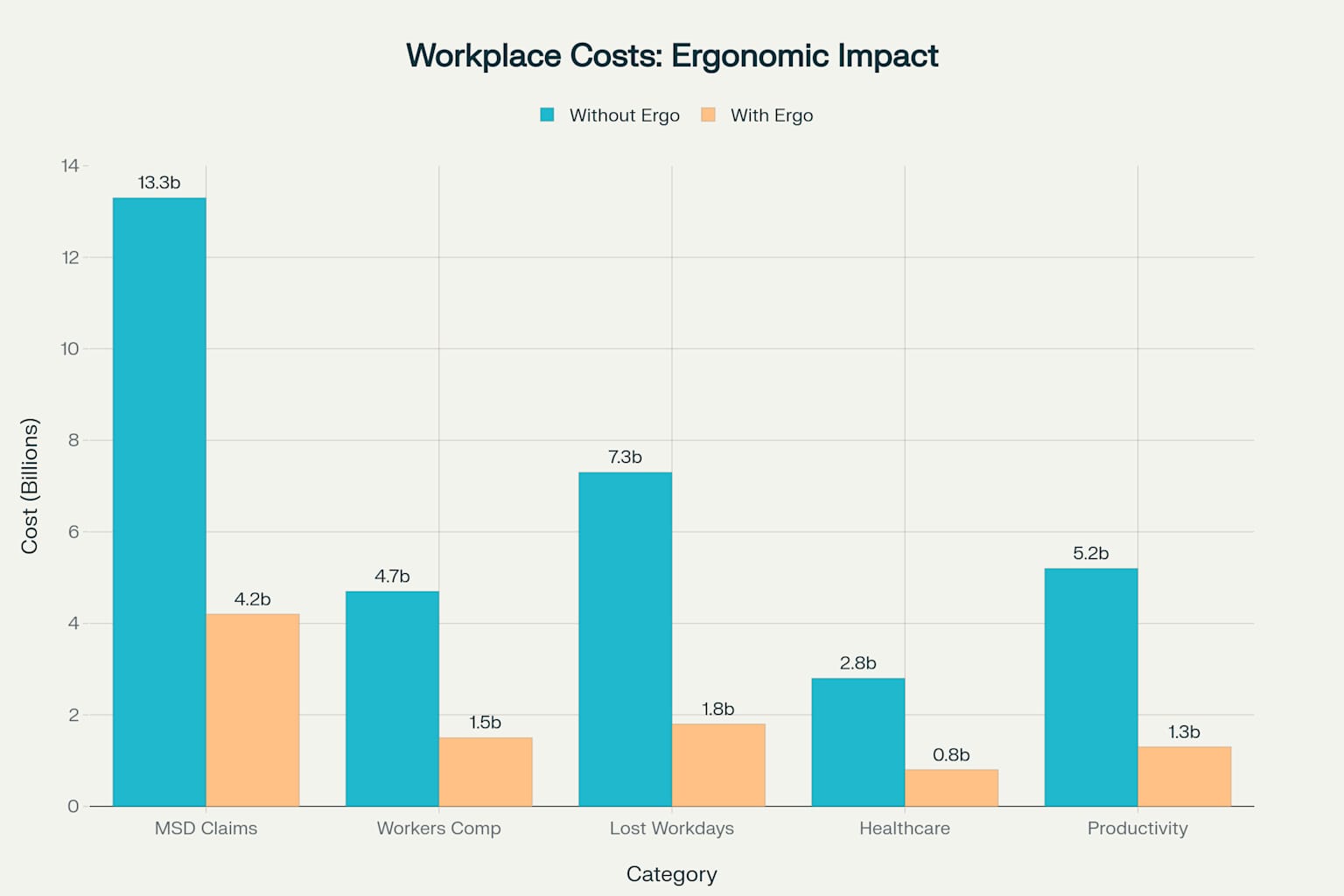
Annual workplace costs comparison showing the significant financial benefits of implementing ergonomic interventions in businesses
Cost reduction represents the most immediate and measurable benefit of ergonomic interventions. Companies implementing comprehensive ergonomic programmes experience a 59% average reduction in musculoskeletal disorders and a 68% decrease in workers’ compensation costs. Lost workdays decline by 75%, while restricted duty days decrease by 53%. These improvements translate directly to bottom-line savings, as businesses avoid the substantial costs associated with workplace injuries and their aftermath.
KeySpan Energy achieved a remarkable 400% return on investment through their ergonomics programme, while Blue Cross Blue Shield of Rhode Island reduced workers’ compensation costs by 89% following ergonomic improvements. These case studies demonstrate that well-designed ergonomic interventions can deliver exceptional financial returns while simultaneously improving employee welfare.
Productivity and Performance Benefits
Beyond cost reduction, ergonomic workspaces drive significant productivity improvements. Research from the University of Leicester found that ergonomic office designs can increase productivity by up to 40%. This improvement stems primarily from the reduction in work-related discomfort and fatigue that allows employees to maintain focus and concentration throughout their working day.
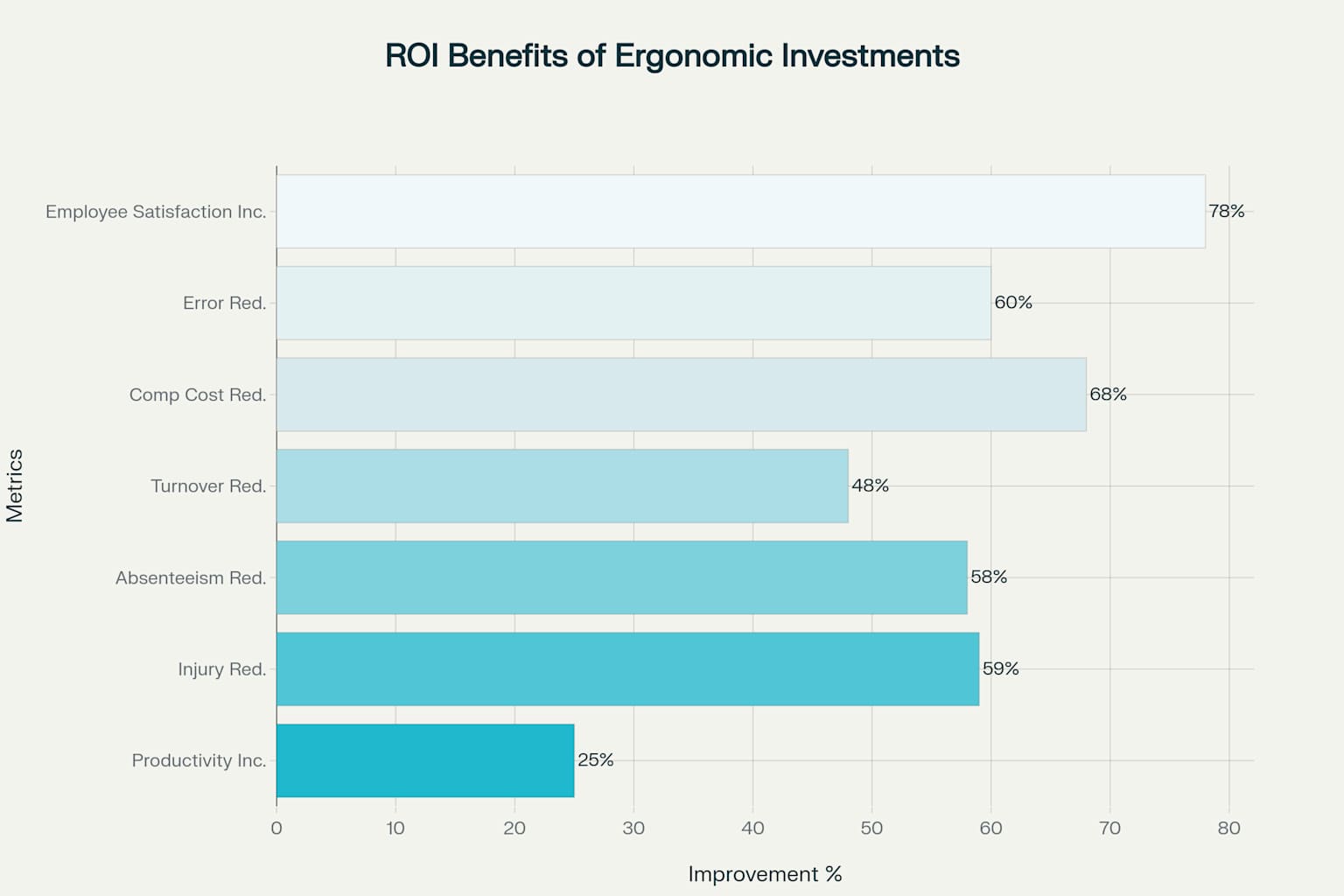
ROI benefits demonstrating the measurable improvements businesses achieve through ergonomic workplace investments
Employees in ergonomically optimised workspaces complete tasks 15% faster compared to those in poorly designed environments. The productivity gains extend beyond speed improvements to include enhanced work quality, with Cornell University research showing that proper ergonomic desk setups can reduce errors by up to 60%. This combination of increased speed and improved accuracy creates substantial value for organisations across all sectors.
Employee satisfaction serves as another critical driver of business performance. Companies that invest in ergonomic furniture report a 78% increase in employee retention. This improvement in retention rates delivers substantial cost savings, as replacing experienced employees involves significant recruitment, training, and productivity loss costs. The relationship between ergonomic investment and employee satisfaction creates a positive cycle that reinforces business performance over time.
Comprehensive Solution Effectiveness
Different ergonomic solutions deliver varying levels of benefit depending on implementation and user needs. Research demonstrates that ergonomic chairs provide the highest pain reduction benefits at 65%, combined with 20% productivity improvements. Height-adjustable desks offer 45% pain reduction and 15% productivity gains, while lumbar support systems deliver 55% pain reduction with 22% productivity enhancement.
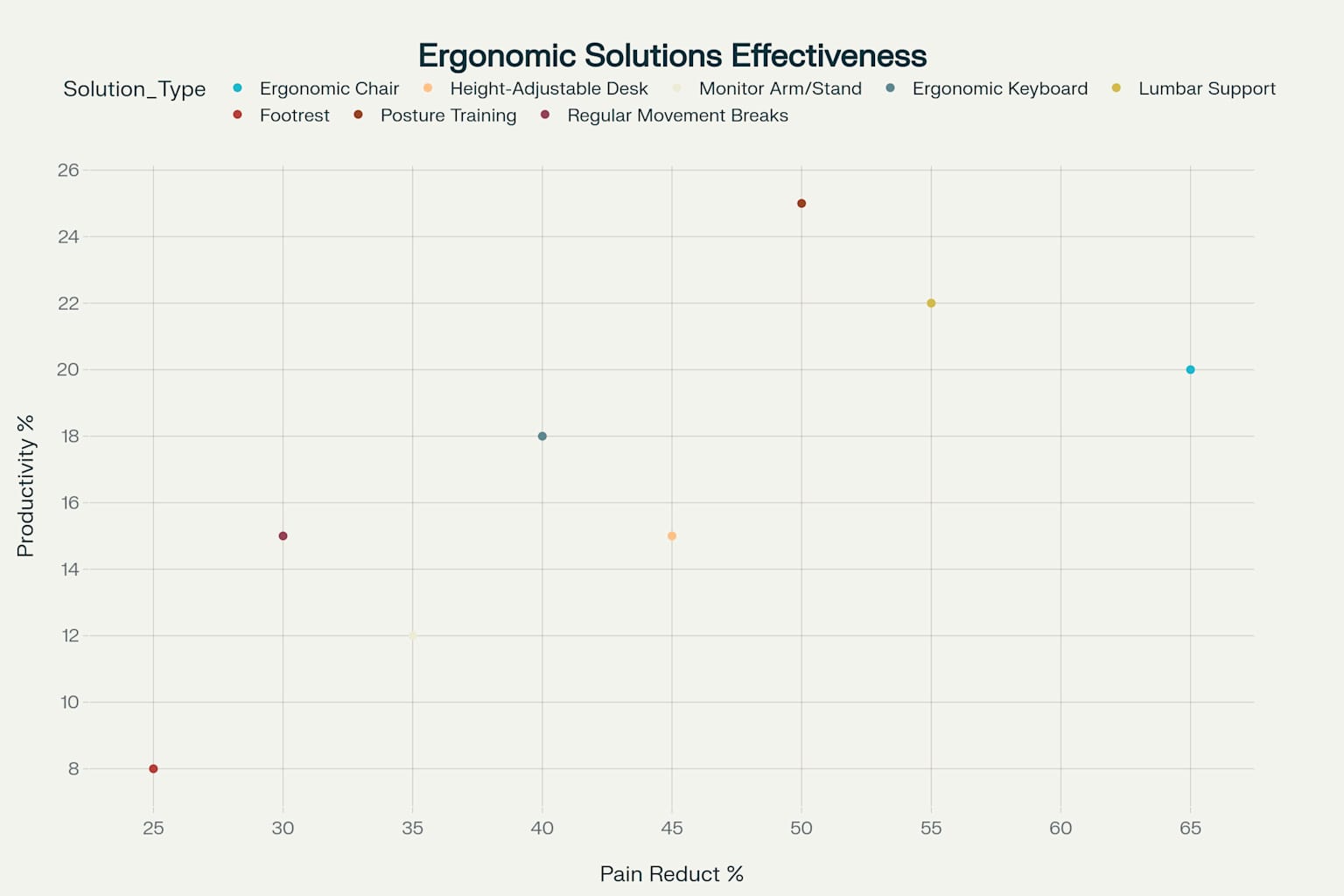
Effectiveness analysis of various ergonomic solutions showing the relationship between pain reduction and productivity improvement
| Solution_Type | Pain_Reduction_Percentage | Productivity_Improvement |
|---|---|---|
| Ergonomic Chair | 65 | 20 |
| Height-Adjustable Desk | 45 | 15 |
| Monitor Arm/Stand | 35 | 12 |
| Ergonomic Keyboard | 40 | 18 |
| Lumbar Support | 55 | 22 |
| Footrest | 25 | 8 |
| Posture Training | 50 | 25 |
| Regular Movement Breaks | 30 | 15 |
The effectiveness of ergonomic solutions extends beyond individual components to encompass comprehensive workplace design. Posture training programmes achieve 50% pain reduction and 25% productivity improvements, highlighting the importance of education alongside equipment provision. Regular movement breaks, while delivering smaller individual benefits of 30% pain reduction and 15% productivity improvement, represent cost-effective interventions that complement other ergonomic investments.
Monitor arms and ergonomic keyboards provide targeted benefits for specific workplace challenges. Monitor positioning reduces neck strain and eye fatigue, delivering 35% pain reduction and 12% productivity improvement. Ergonomic keyboards address repetitive strain injuries, providing 40% pain reduction and 18% productivity enhancement. These targeted solutions allow organisations to address specific workplace challenges while building comprehensive ergonomic programmes.
Technology Trends Transforming Workspaces in 2025
The ergonomic landscape is experiencing rapid technological advancement, with artificial intelligence and smart systems leading innovation. AI-powered ergonomic monitoring systems are projected to increase from 15% current adoption to 45% by the end of 2025. These systems provide real-time posture feedback and adjustment recommendations, enabling proactive intervention before discomfort develops into injury.
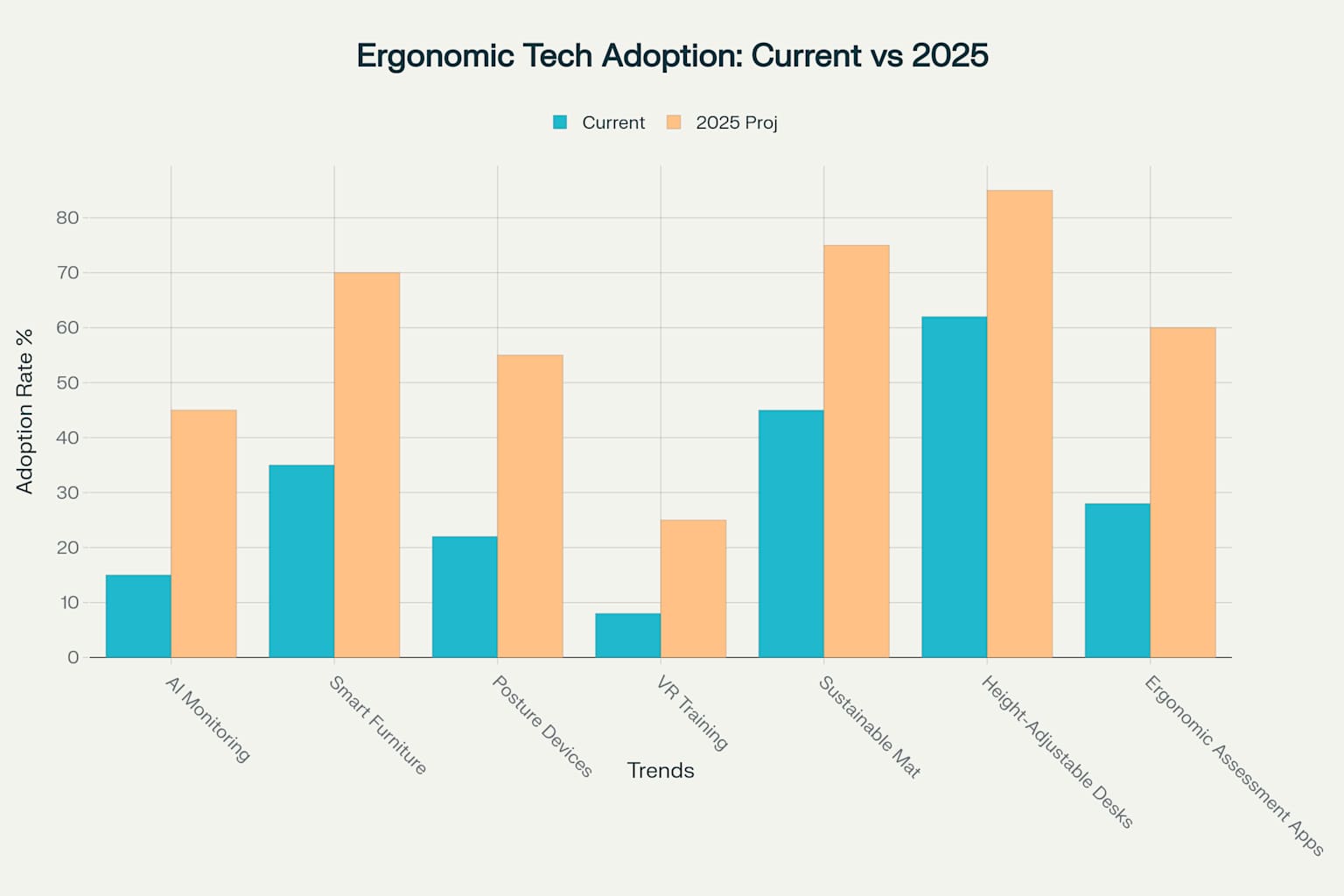
Ergonomic technology adoption trends showing the expected growth in workplace ergonomic solutions by 2025
| Trend | Current_Adoption_Rate | Projected_2025_Rate |
|---|---|---|
| AI-Powered Ergonomic Monitoring | 15 | 45 |
| Smart Adjustable Furniture | 35 | 70 |
| Wearable Posture Devices | 22 | 55 |
| Virtual Reality Training | 8 | 25 |
| Sustainable Materials | 45 | 75 |
| Height-Adjustable Desks | 62 | 85 |
| Ergonomic Assessment Apps | 28 | 60 |
Smart adjustable furniture represents another significant growth area, with adoption rates expected to rise from 35% to 70% during 2025. These systems automatically adjust to user preferences and can modify positioning throughout the day to encourage movement and optimal posture. Wearable posture devices are gaining traction, with adoption projected to increase from 22% to 55% as organisations seek objective data on employee ergonomic risks.

A futuristic open-plan office showcases integrated holographic displays and data visualizations, depicting a highly digital and collaborative workspace.
Sustainable materials are becoming increasingly important in ergonomic furniture selection. Bamboo furniture adoption is expected to grow from 45% to 75% as organisations balance ergonomic benefits with environmental responsibility. Bamboo offers superior strength characteristics compared to traditional materials while providing rapid renewability that supports corporate sustainability goals.
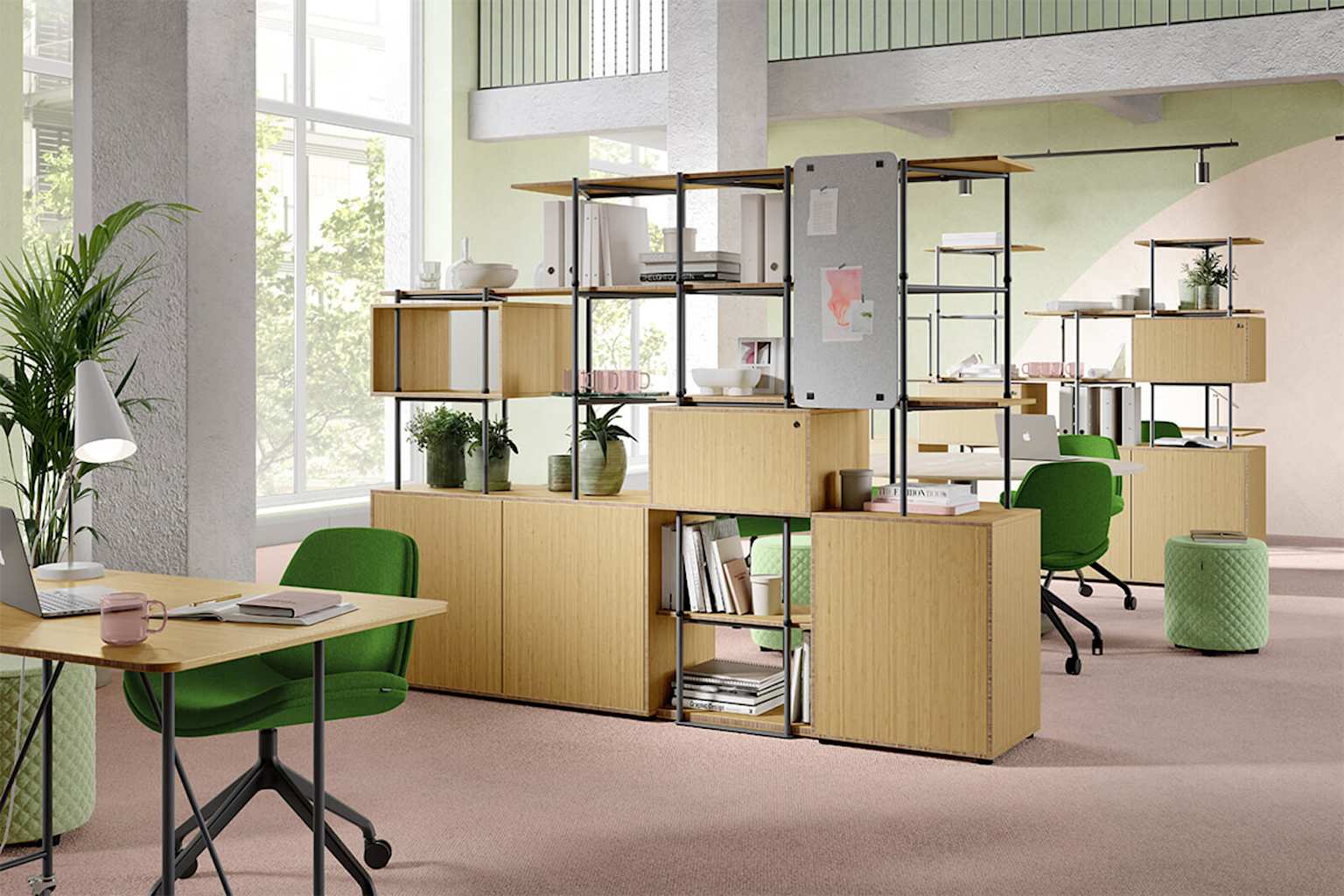
A contemporary office space showcasing modular bamboo furniture and ergonomic green chairs, highlighting sustainable and functional design.
Virtual reality training for ergonomic education is emerging as a powerful tool, with adoption projected to increase from 8% to 25% by late 2025. VR systems allow employees to experience the consequences of poor ergonomic practices and practice correct techniques in controlled environments. Height-adjustable desks continue to see strong adoption growth, rising from 62% to an expected 85% as organisations recognise their fundamental importance in modern workspace design.

Implementation Best Practices
Successful ergonomic programme implementation requires comprehensive planning and employee engagement. Organisations should begin with thorough assessments of current workplace conditions and employee needs. This assessment phase identifies priority areas for intervention and establishes baseline measurements for tracking improvement.

Workstation setup infographic illustrating ergonomic posture tips and health advice for workplace wellness from The University of Western Australia.
Employee education plays a crucial role in programme success. Workers must understand proper posture techniques, equipment adjustment procedures, and the importance of regular movement throughout the workday. Training programmes should combine theoretical knowledge with practical application, allowing employees to practice correct techniques under guidance.

Comparison of incorrect and correct ergonomic postures for office work totalwellnesshealth
Equipment selection should prioritise adjustability and user customisation. Different employees have varying physical requirements, and ergonomic solutions must accommodate this diversity. Chairs should offer comprehensive adjustment options including seat height, backrest angle, armrest position, and lumbar support. Desks should provide height adjustment capabilities to support both sitting and standing work positions.

A modern ergonomic office workspace featuring a white adjustable standing desk and an ergonomic office chair.

Examples of our office chairs can be found here.
Technology integration enhances programme effectiveness when implemented thoughtfully. Wearable devices can provide objective feedback on posture and movement patterns, while smart furniture systems can encourage healthy behaviours through automated adjustments. However, technology should complement rather than replace fundamental ergonomic principles and human-centred design.
Future Outlook and Recommendations
The ergonomic workplace landscape will continue evolving rapidly through 2025 and beyond. Organisations that invest early in comprehensive ergonomic programmes position themselves advantageously for long-term success. The convergence of health awareness, technological capability, and economic necessity creates unprecedented opportunities for workplace transformation.

A woman works at an ergonomically designed workstation featuring a footrest, lumbar support, and dual monitors displaying charts and graphics.
Business leaders should approach ergonomic investment as a strategic initiative rather than a compliance requirement. The substantial returns available through comprehensive programmes justify significant upfront investment, particularly when considering the long-term costs of employee health issues and turnover. Organisations should develop multi-year implementation plans that allow for gradual improvement while measuring progress against established benchmarks.
The integration of AI and smart systems will accelerate dramatically over the coming years. Companies should prepare for this transition by establishing data collection capabilities and developing employee comfort with technology-assisted ergonomic monitoring. Early adoption of emerging technologies provides competitive advantages in talent attraction and retention.
Conclusion
The evidence overwhelmingly supports substantial investment in ergonomic workplace design as a strategic business imperative. The financial returns, ranging from 3:1 to 15:1, represent exceptional investment opportunities that simultaneously improve employee welfare and business performance. As organisations navigate the challenges of hybrid working, technological advancement, and competitive talent markets, ergonomic excellence provides a foundation for sustainable success.
The transformation from traditional office environments to ergonomically optimised workspaces represents more than incremental improvement. It constitutes a fundamental shift towards human-centred design that recognises employee wellbeing as integral to business success. Companies that embrace this transformation position themselves for enhanced productivity, reduced costs, and improved employee satisfaction that drives long-term competitive advantage.
